
AI Customer Service Agent Working Alongside Humans
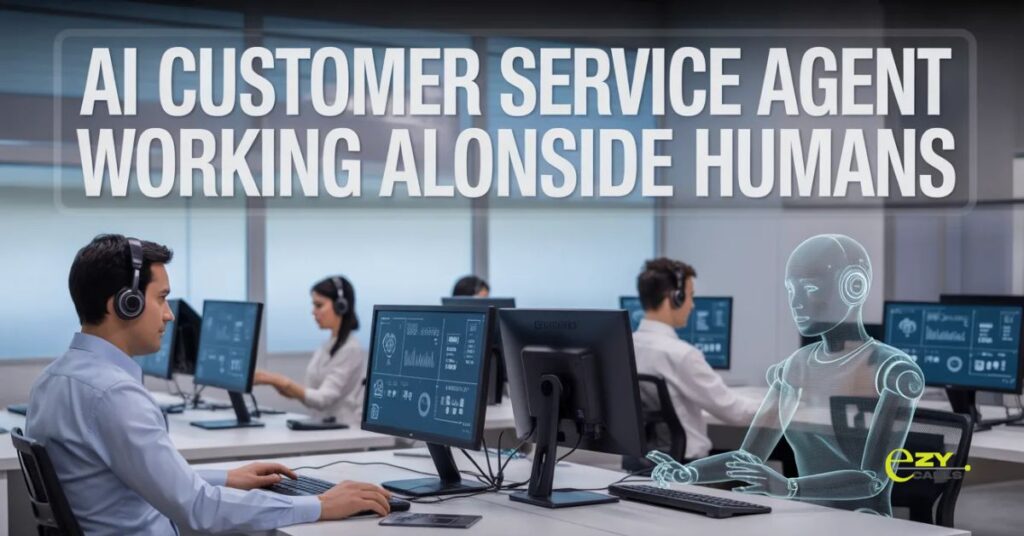
AI agents shouldn’t replace human customer service completely. Best use is handling repetitive questions while humans tackle complex situations. AI customer service agent technology works when it knows its limits and hands off appropriately, and companies implementing it right see efficiency gains without service quality suffering.
Most businesses approach AI agents as complete human replacement. Wrong mindset leading to frustrated customers and failed implementations.
What AI Agents Actually Handle
- Traditional customer service puts humans on every interaction. A simple password reset takes the same agent time as a complex technical problem.
- AI customer service agents handle routine predictable inquiries. Account information, basic troubleshooting, common questions answered instantly. Frees humans for situations requiring judgment and empathy.
- Knowing what AI should and shouldn’t handle determines success or failure.
Where AI Agents Excel
- Frequently asked questions answered instantly. Business hours, return policies, account status. No wait time for simple information.
- Basic troubleshooting steps automated. “Have you tried restarting?” type guidance. Walk through standard procedures before human involvement.
- Information retrieval from databases. Order status, account balance, transaction history. Data lookup faster than human searching.
- Simple transactions processed automatically. Password resets, address changes, preference updates. Routine account modifications without a human agent.
- After-hours initial response. Customer contacts outside business hours. AI provides immediate acknowledgment and basic help until humans are available.
- Multi-language supports scaling easily. AI handles multiple languages simultaneously. Eliminates the need for specialized language agents for basic inquiries.
Core AI Agent Capabilities
- Natural language understanding. Comprehends various ways customers phrase the same question. Doesn’t require exact keyword matching.
- Context awareness across conversation. Remember what the customer said earlier. Maintains continuity instead of treating each message separately.
- Graceful handoff to humans. Recognizes when it can’t help. Transfers smoothly with context preserved.
- Learning from interactions. Improves responses based on outcomes. Gets better at handling queries over time.
- Sentiment detection. Identifies frustrated or angry customers. Escalates appropriately before situations worsen.
- Integration with knowledge bases. Pulls accurate information from documentation. Answers stay current as knowledge updates.
Different Implementation Approaches
- Chat-only AI for website support. Text-based assistance on the company site. Handles initial inquiries before offering human chat.
- Voice AI for phone systems. Automated phones support understanding spoken questions. Routes calls appropriately or provides self-service options.
- Email response automation. AI drafting replies to common email inquiries. Humans review and send or AI handles completely.
- Social media monitoring and response. AI watching for customer questions on social platforms. Quick responses to public inquiries.
- Hybrid approach with AI assistance. AI suggests responses to human agents. Person reviews and sends with modifications.
Making AI Agents Work
- Start with truly simple inquiries. Don’t tackle complex scenarios first. Build confidence with basic questions before expanding.
- Monitor customer satisfaction specifically with AI. Track ratings when AI handles requests. Ensure quality doesn’t drop versus human service.
- Easy escalation path to humans. Customers frustrated with AI get human fast. No forcing people through automated mazes.
- Clear about when they’re talking to AI. Transparency builds trust. Pretending AI is human backfires when discovered.
- Continuous training on actual conversations. Feed AI real customer interactions. Learn from successes and failures.
- Human oversight of AI responses. Especially early on, review what AI tells customers. Catch problems before becoming patterns.
Common AI Agent Mistakes
- Deploying before AI is ready. Rushing implementation with poorly trained systems. Customer frustration damages reputation quickly.
- Handling too many inquiry types. Trying to solve everything with AI. Better to excel at a few things than fail at many.
- No clear path to human help. Customers are stuck in an AI loop unable to reach people. Infuriating experience destroys satisfaction.
- Robotic unnatural responses. Obviously scripted AI language. Makes interactions feel impersonal and frustrating.
- Not updating AI as business changes. Products change, policies update, but AI responses stay stale. Outdated information is worse than no information.
- Measuring success only by cost savings. Ignoring customer experience impact. Cheap but terrible service isn’t actually successful.
Customer Expectations Management
- People want fast answers for simple stuff. AI perfect for this use case. Instant response beats waiting for a human agent.
- Complex problems need human touch. Emotional situations, unusual circumstances, judgment calls. AI frustrates when humans need it.
- Transparency about AI interaction. Most accept AI for basic questions. Appreciate knowing what they’re dealing with.
- Easy human access when needed. “Talk to a person” should always work. Respect customer preference for human help.
- Quality matters more than speed. A fast wrong answer is worse than a slower correct one. AI must be accurate, not just quick.
Privacy and Data Concerns
- AI processing customer information requires security. Conversations contain sensitive data. Protect appropriately with encryption and access controls.
- Data retention policies matter. How long is keeping conversation records? What’s done with customer information?
- Training data privacy. Using customer conversations to train AI needs consent. Privacy regulations require proper handling.
- Bias in AI responses. Systems trained on historical data might reflect biases. Monitor for unfair treatment patterns.
- Cross-border data considerations. Where does conversation data get processed? International privacy laws create complexity.
Measuring AI Agent Success
- Resolution rate without human intervention. What percentage of inquiries AI handles completely? Primary success metric.
- Customer satisfaction with AI interactions. People happy with automated service? Track ratings specifically for AI conversations.
- Average handling time reduction. Human agents freed up for complex issues? Time savings from AI automation.
- Escalation rate to humans. How often does AI need to transfer to a person? Lower is better but shouldn’t be zero.
- Accuracy of information provided. AI giving correct answers? Incorrect information damages trust severely.
- Cost per interaction comparison. AI versus human cost. Financial impact justifying investment.
EZY CALLS AI Agent Approach
- Platforms like Ezy Calls implement AI agents understanding limitations. Not trying to replace humans completely. Tools augmenting service with appropriate automation.
- What makes Ezy Calls practical? AI knowing when to hand off to humans. Easy escalation, transparent interactions, continuous improvement from feedback. Built for realistic service enhancement not theoretical replacement.
- For companies wanting efficiency without sacrificing service quality, solutions like this work. Smart automation recognizes technology’s appropriate role.
- AI customer service agent technology succeeds through appropriate deployment. Good AI handles what it should, delegates what it shouldn’t. Bad AI frustrates everyone trying to do too much.
- Better service combines AI efficiency with human judgment. Technology should complement people, not replace them entirely.
Questions About AI Agents
Will customers hate talking to AI instead of people?
- Depends on the situation honestly. Simple quick questions? Most prefer fast AI responses. Complex emotional issues? They want humans. Match AI uses appropriate scenarios.
How do we prevent AI from giving wrong information?
- Start with narrow well-defined topics. Test thoroughly before launch. Monitor responses continuously and update knowledge base regularly. Humans review flagged conversations.
What’s a realistic timeline for an AI agent providing value?
- Few weeks for basic FAQ handling. Several months for complex scenarios. Start simple, expand gradually as AI learns your customers and business.
