Virtual Call Center Software That Makes Remote Support Work
- Running a call center from a single physical location made sense when the alternative was not having a call center at all. That constraint no longer exists. The technology that supports customer communication has developed to the point where a team distributed across different locations can operate with the same coordination and visibility as one sharing a floor.
- That shift has changed what is possible for businesses of every size. Not just large enterprises with the budget for enterprise infrastructure. Growing businesses that need proper customer communication capability without the overhead of a dedicated facility.
- Virtual call center software is what makes that possible. Not a compromise version of call center capability delivered remotely but the same capability delivered without the geographic constraint.
What Virtual Call Center Software Actually Provides
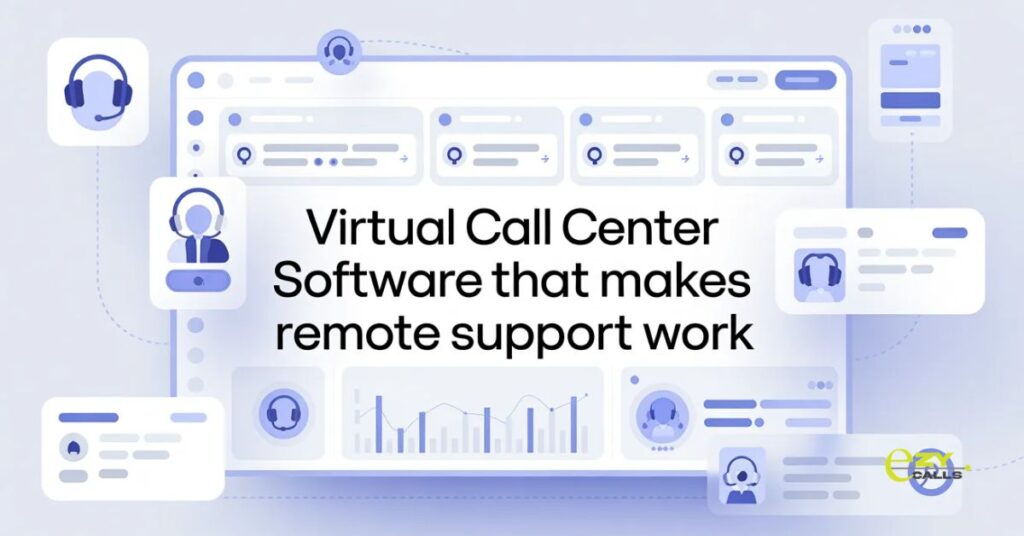
- The core function is straightforward. Customer contacts arriving across multiple channels get routed to agents who can be anywhere with an internet connection. The infrastructure that would previously have required physical hardware in a specific location runs in the cloud. The agent experience is delivered through a browser or a lightweight application rather than through hardware tied to a specific desk.
- Beyond that baseline the capability varies significantly across platforms.
- Intelligent routing. Contacts directed to the agent best suited to handle them rather than just the next available one. Skills based routing that matches the nature of the contact to the agent capability. Queue management that gives customers accurate expectations about wait times rather than silence.
- Omnichannel handling. Phone calls, chat, email and social media contacts managed through a single interface. Agents who see the full context of a customer’s contact history regardless of which channel previous interactions happened through.
- Supervisor tools that work remotely. The monitoring, coaching and performance management capability that supervisors need to manage a distributed team. Real time visibility into what agents are handling. The ability to listen in, whisper to coaches or intervene when a call needs support.
- Virtual call center software that delivers all of these capabilities properly gives a distributed team the same operational coherence as a co-located one.
The Flexibility Advantage
- The most immediate practical advantage of virtual call center software for growing businesses is what it enables in terms of how the team is structured and how capacity gets managed.
- Geographic flexibility. Agents who do not need to be in a specific location can be hired from a broader talent pool. The business is not limited to candidates who can commute to a specific office. That flexibility matters in competitive hiring markets where the right candidates are not always local.
- Time zone coverage. A distributed team can provide coverage across more hours without requiring any individual agent to work unsociable shifts. Agents in different locations covering different hours of the customer day without the cost of night shift premiums or the human cost of asking people to work hours that do not suit them.
- Scalability without infrastructure investment. Adding agents to a virtual call center does not require additional physical space, hardware or network infrastructure at a specific location. New agents get access to the system with the same onboarding process regardless of where they are based.
- Business continuity. A single location call center is vulnerable to anything that affects that location. A virtual operation distributed across multiple locations is inherently more resilient. If one location has a problem the operation continues from others without customers experiencing the disruption.
What Remote Management Requires
- Virtual call center software enables remote operation. It does not automatically make remote management easy. The management practices that work in a co-located environment need deliberate adaptation for a distributed team.
- Visibility into what agents are doing is more structured in a remote environment. The informal awareness that comes from being in the same room is absent. Supervisor tools that provide real time visibility into queue status, agent activity and contact outcomes replace that informal awareness with something more systematic.
- Communication that happens naturally through proximity in a physical call center needs to be intentional in a virtual one. Team meetings that keep distributed agents connected to each other and to the organisation. One to one check ins that provide the coaching and development conversations that would otherwise happen informally. Communication rhythms that prevent distributed agents from feeling isolated from the team.
- Quality management that relies on call recording and systematic review rather than the incidental awareness that comes from being able to hear what agents are handling. Coaching that is delivered through structured sessions rather than opportunistic moments.
- Remote management done well produces outcomes comparable to co-located management. Remote management that tries to replicate co-located management without adapting to the different environment produces worse outcomes than either approach done properly.
The Technology Foundation
- Virtual call center software that works well for a distributed team has specific technical requirements that go beyond the basic call handling capability.
- Reliability that does not depend on a specific network or location. Agents connecting from home networks or remote offices need the same quality of connection as agents in a corporate network environment. Platforms that degrade significantly on consumer grade internet connections create a two tier experience between agents in different settings.
- Security that does not require physical access controls. A co-located call center controls who has physical access to the environment. A virtual one needs security controls that work regardless of where the agent is connecting from. Authentication requirements. Data handling that complies with privacy obligations regardless of the agent’s location. Controls that prevent customer data from being inappropriately accessed or retained on personal devices.
- Integration with the tools the team already uses. Customer records in the CRM accessible during calls without switching systems. Ticketing systems that create and update records automatically from call outcomes. Workforce management tools that handle scheduling across a distributed team. A virtual call center that sits in isolation from these systems creates manual overhead that undermines the efficiency gains that the virtual model is supposed to deliver.
AI in the Virtual Call Center
- Virtual call center software in 2026 increasingly includes AI capabilities that are particularly valuable in a distributed environment.
- Real time agent assistance. AI that surfaces relevant information during a live call without the agent needing to search for it. In a physical call center supervisors and experienced colleagues are available to support agents with difficult queries. In a distributed environment that support is less accessible. AI assistance partially fills that gap by making information available automatically rather than requiring the agent to know who to ask.
- Automated quality monitoring. In a co-located environment supervisors can dip in and out of calls naturally. In a distributed environment systematic monitoring requires more deliberate effort. AI that analyses all calls automatically against defined quality criteria makes quality management more comprehensive without proportionally increasing supervisor workload.
- Intelligent routing that improves over time. AI that learns from how contacts are resolved and refines routing decisions based on what actually produces good outcomes rather than just on static rules defined during setup.
Building a Customer Communication Operation With Virtual Call Center Software
- The businesses running effective virtual call center operations are not doing so by approximating what a physical call center does remotely. They are taking advantage of what a virtual model makes possible that a physical one does not. Broader talent access. More flexible coverage. Greater resilience. Lower infrastructure cost.
- Virtual call center software is what enables that model to work operationally. The routing intelligence. The supervisor tools. The omnichannel capability. The integration with broader customer management systems. Together these create an operation that delivers for customers regardless of where the team is located.
- EZY CALLS is a platform built for businesses that want to build that kind of customer communication operation. Designed for the realities of distributed teams and virtual operations rather than for the assumption that everyone is in the same room.
Questions Worth Asking
How do we maintain team culture in a distributed call center environment?
- Deliberate communication rhythms replace the informal culture building that happens naturally in a shared space. Regular team sessions, individual check ins and visible recognition of good work across the team all contribute. Technology enables the operation. Culture requires intentional investment.
What internet connection quality do agents need for virtual call center software to work properly?
- Most platforms specify minimum requirements. Test actual performance on the connection types agents will use rather than assuming the specification is sufficient. Consumer broadband varies significantly and peak time degradation affects call quality in ways that are not visible during off peak testing.
How do we handle data security when agents are working from home or remote locations?
- Define clear data handling requirements before agents go live. What can and cannot be accessed on personal devices. How customer data gets handled during and after calls. What authentication is required. Build these requirements into the onboarding process rather than addressing them after security issues arise.