
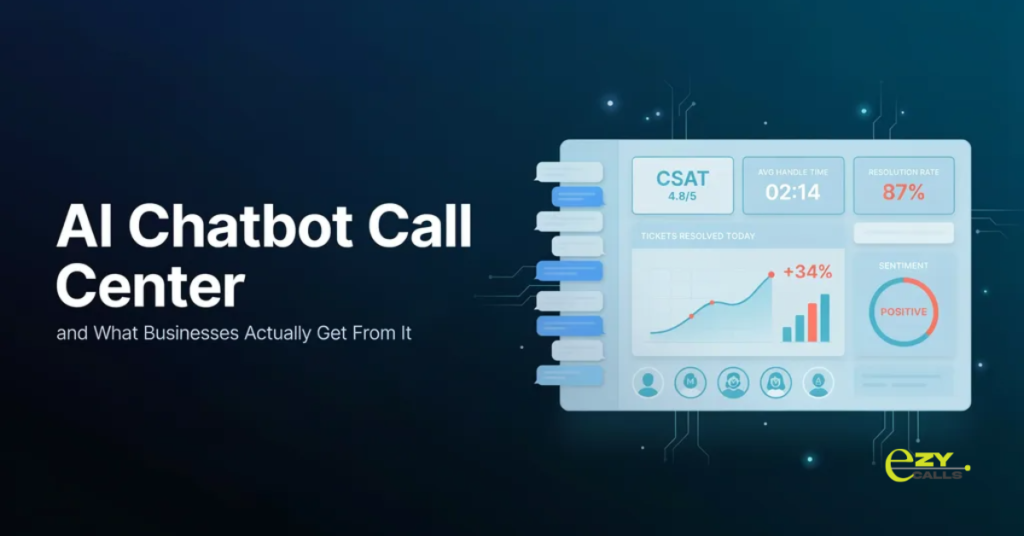
AI Chatbot Call Center and What Businesses Actually Get From It
- The chatbot has had a complicated journey in customer service. First there was the excitement. Automated responses at scale. No queues. 24 hour availability. Then came the disappointment. Chatbots that could not understand anything beyond exact keyword matches. Customers going around in circles. The same frustrating loop that made people hate automated customer service even more than they already did.
- What exists now in 2026 is genuinely different from that early chatbot experience. Not perfect. Not the end of human agents. But meaningfully more capable in ways that change what is achievable for businesses that implement AI chatbot call center capability thoughtfully.
- Understanding what the current generation of AI chatbots actually delivers and where the limitations still sit is what separates implementations that improve customer experience from ones that add a layer of technology between customers and getting what they need.
What Has Actually Changed
- The difference between early chatbots and current AI chatbots is not incremental. It is architectural.
- Early chatbots matched keywords to scripted responses. The customer had to phrase their query in a way the bot was specifically trained to recognise. Anything outside those patterns produced a response that was either irrelevant or an admission of failure. Customers adjusted their language to fit the machine rather than the machine understanding how customers naturally speak.
- Current AI chatbots understand natural language in a way that earlier systems genuinely did not. A customer who types something like I ordered something last week and it still has not shown up even though the website said 3 days is not using any specific keywords. They are describing their situation in the way a person naturally would. A current AI chatbot understands what they mean, what they need and what information it needs to access to help them. That shift from keyword matching to genuine language understanding changes what can be automated reliably.
- Context retention has also improved significantly. Earlier chatbots treated each message as isolated input. Current systems maintain the thread of the conversation. A customer who provided their order number two messages ago does not need to provide it again. The AI builds on what has already been said rather than starting fresh with each exchange.
- Integration with business systems has matured. An AI chatbot call center that has access to the customer’s account information, order history and current status can provide specific answers rather than generic responses. That specificity is often the difference between a chatbot interaction that resolves the query and one that sends the customer to an agent anyway because the chatbot could not access what it needed to actually help.
What AI Chatbots Handle Well
- Being specific about which contact types suit chatbot automation is more useful than general claims about capability.
- Order and delivery queries. Where is my order? When will it arrive? Why has it not come yet. Can I change the delivery address? These are high volume contacts with specific factual answers available in the order management system. A chatbot connected to that system handles them accurately and immediately without queue time or agent involvement.
- Account management. Checking account status. Updating contact details. Resetting access. Understanding billing. These follow predictable patterns with specific information from account systems. Chatbots handle them reliably when the system integrations are in place.
- Product and service information. What does this product include? How does this service work? What are the pricing options? What is the returns policy? These are information requests with defined answers. A well maintained knowledge base allows the chatbot to answer them accurately and consistently without variation depending on which agent happens to respond.
- Appointment scheduling and changes. Booking. Rescheduling. Cancelling. Confirming. These conversations follow predictable structures that chatbots handle cleanly when connected to scheduling systems.
- Standard troubleshooting. The common issues with known resolution paths. The product that needs a specific reset sequence. The service that requires a particular configuration step. The chatbot that can walk a customer through a troubleshooting process handles a significant volume of support contacts without escalation.
- What these contact types share is predictability. Known questions. Specific answers. Defined resolution paths. AI chatbots handle predictable well. Genuinely novel situations are where the reliability drops.
Where Chatbots Still Fall Short
- The AI chatbot call center limitations that matter most for real contact center operations are worth understanding specifically.
- Complex multi-issue queries. A customer with three connected problems that each affect the others. The resolution requires holding multiple threads simultaneously and making judgment calls about how they interact. This is where chatbot handling produces frustrated customers who have to explain their situation twice when they eventually reach an agent.
- Emotional situations that need human acknowledgment. A customer who is upset about something significant. Who needs to feel heard before they need to be helped. The emotional intelligence that a person brings to these interactions is qualitatively different from what current AI chatbots provide. Attempting to keep these customers in the automated flow damages the relationship at the moment it matters most.
- Queries outside the knowledge base. The question the chatbot was not prepared for. The situation that did not exist when the knowledge base was built. Chatbots on these queries either produce wrong answers confidently or fall back to responses that do not help. Neither outcome serves the customer.
- Nuanced situations requiring judgment. When the right answer depends on context that is not captured in structured data. When the customer’s circumstances require an exception to the standard process. When the situation is unusual enough that a defined rule does not clearly apply. These require the human judgment that chatbots do not reliably provide.
Building an AI Chatbot Implementation That Actually Works
- The difference between AI chatbot call center implementations that improve customer experience and those that frustrate customers is almost entirely in implementation decisions rather than in the technology itself.
- Information accuracy before going live. The chatbot that works from accurate current information gives accurate answers. The chatbot working from outdated product details or policies that changed last month gives wrong answers confidently and at scale. Every piece of information the chatbot draws from needs verification before live customer interactions begin and maintenance as the business changes.
- Honest scope definition at launch. Starting with the highest volume contact types that have the clearest resolution paths. Building confidence and operational understanding before expanding. The narrow implementation that works well is significantly better than the broad implementation that works partially because the narrow one builds trust while the broad one creates problems everywhere at once.
- Escalation that feels like service not failure. The moment a chat needs a person should feel immediate and smooth. The agent receives the full context of the chatbot conversation. The customer does not repeat themselves. The transition feels like being connected to someone who can help more rather than like having wasted time with a bot. This escalation quality is often what separates implementations that earn positive customer responses from those that earn complaints about the chatbot.
- Conversation design that reflects how customers actually communicate. Not how the business would like customers to communicate. The natural language patterns of the actual customer base. The ways customers describe their situations when they are not thinking about how to phrase things for a system. Good conversation design accounts for variation in how real customers communicate rather than assuming they will use the phrasing that makes the chatbot work best.
The Difference Between Chatbot and Voice AI in a Contact Center
- An AI chatbot call center operation typically includes both text-based chat interactions and voice interactions with different AI approaches serving different channels.
- Chat and messaging contacts allow slightly more processing time between exchanges. The customer types. The AI processes. The response appears. A second or two of processing is invisible to the customer. This gives chat-based AI slightly more flexibility in how it handles complex language than voice AI where latency is immediately noticeable.
- Chat also allows customers to refer to information in previous messages more easily. The conversation is visible. The customer can scroll up to see what was said earlier. This context visibility changes how customers communicate in chat compared to voice.
- Voice AI needs to sound natural in real time. The latency that is invisible in chat becomes noticeable and uncomfortable in voice. The response needs to arrive within a conversational timeframe or the interaction feels wrong even if the content of the response is accurate. Voice AI in 2026 has improved significantly on this latency challenge but the constraint remains real.
- Most contact centers deploy both text-based chatbot capability and voice AI capability as part of a broader AI chatbot call center strategy. Understanding how these work together rather than treating them as separate decisions produces more coherent customer experiences across channels.
The Data That Chatbot Interactions Generate
- Every chatbot interaction generates information that has value beyond the immediate customer service outcome. This is one of the less celebrated aspects of AI chatbot contact center capability and one that deserves more attention.
- What customers ask about most frequently. The topics that generate the most chatbot contacts reveal where customers need information that they are not finding elsewhere. That intelligence is valuable for improving product documentation, website content and onboarding processes in ways that reduce future contact volume.
- Where the chatbot escalates most often. The contact types that regularly exceed chatbot capability reveal either knowledge gaps that can be addressed through knowledge base improvements or genuinely complex contact types that should probably be routed to agents from the start rather than through the chatbot.
- How customers describe their problems. The natural language that customers use to describe their situations is often different from the language the business uses internally. This gap between internal language and customer language shows up in search terms, in support contacts and in how customers describe problems to each other. Chatbot interaction data reveals it systematically.
- How long conversations take before resolution. Long chatbot conversations that eventually escalate without resolution reveal where the chatbot is attempting to handle something it cannot reliably serve. Short conversations with high resolution rates reveal the contact types where chatbot automation is working well.
- This data is only valuable if someone is paying attention to it and acting on what it reveals. The operations that use chatbot interaction data to continuously improve their customer experience extract more long-term value from the investment than those that track only whether contacts were handled automatically.
Keeping the Chatbot Current as the Business Changes
- This is where most AI chatbot call center implementations go wrong after launch. Not in the initial build but in what happens when the business changes and the chatbot does not.
- A new product launches. The chatbot does not know about it because nobody updated the knowledge base. Customers who ask about the new product get responses that do not reflect current reality or get escalated unnecessarily because the chatbot cannot handle queries that should be straightforward.
- A policy changes. The chatbot continues to tell customers the old policy because the update that happened in the policy documents did not happen in the chatbot knowledge base. Customers who relied on what the chatbot said and found reality different have a complaint that originated in poor maintenance rather than poor service intention.
- Pricing updates. Promotional periods that end. Service changes. Each of these creates a gap between what the chatbot knows and what is currently true. Managing that gap is the ongoing operational responsibility that determines whether a chatbot remains useful or gradually becomes a source of misinformation.
- Assigning clear ownership for knowledge base maintenance before the chatbot goes live is more important than most implementations treat it. Building that maintenance into existing business processes so that changes in the business automatically trigger knowledge base reviews rather than relying on someone to remember is the approach that keeps chatbots current reliably rather than intermittently.
- EZY CALLS is built for contact centers that want AI chatbot capability that works properly for customers over time rather than impressively at launch. Designed around genuine customer resolution rather than contact deflection. Built to be maintained rather than launched and left.
Questions Worth Asking
How do we decide what the chatbot handles versus what goes straight to a person?
- Look at your actual contact data. The highest volume contact types with the clearest resolution paths are chatbot candidates. Contact types that involve distress, complexity or judgment are not. Starting the categorisation from data rather than from ambition produces a scope that the chatbot can actually deliver on.
How do we measure whether the chatbot is actually helping customers rather than just handling contacts?
- Track resolution rates on chatbot handled contacts specifically. Track how often customers who interacted with the chatbot contact again about the same issue. Compare satisfaction scores from chatbot interactions against human agent interactions on similar contact types. These measurements reveal whether the chatbot is serving customers rather than just processing contacts.
How do we keep the chatbot knowledge current without it becoming a significant ongoing resource commitment?
- Build knowledge review triggers into existing business processes. Product changes prompt a knowledge base review. Policy updates prompt a knowledge base review. Treat the chatbot knowledge base as a live operational document rather than a setup artefact. The maintenance that happens as part of how the business already operates is more reliable than maintenance that depends on someone remembering to check.
