What Businesses Get Wrong About Artificial Intelligence Customer Service and How to Fix It

- A lot of businesses treat customer service like a necessary expense. Keep the team small. Handle the calls. Close the tickets. Move on.
- That approach worked well enough for a long time. It is getting harder to sustain now.
- Customers have more options today. If an experience feels slow or careless they do not complain much. They just leave. And they rarely come back.
- The businesses that are holding onto customers well are doing something different. They are treating service as something worth getting right. Not just something to manage. Artificial intelligence customer service is helping them do that without blowing up their operating costs.
The First Mistake Businesses Make With AI
- When most businesses start looking at AI for customer service the first question is almost always the same. What can we automate to save money?
- That is not the wrong question. But stopping there is.
- The businesses getting real results from artificial intelligence customer service are asking a different question alongside it. What does a genuinely good customer experience look like and can AI help us deliver it more consistently?
- There is a gap between a customer who got a technically correct automated reply and a customer who felt like their issue was properly handled. The first outcome is efficient. The second one builds trust.
- When AI is set up well you get both. When it is set up poorly you get neither.
What Customers Actually Expect Now
- Expectations have shifted quietly over the past few years. Not all at once but steadily.
- People message friends and get a reply in minutes. They search for something and find the answer immediately. Waiting has become something they are less and less willing to do.
- When they contact a business they bring those habits with them. A reply the next morning feels late. Twenty minutes on hold feels long. Two days for an email response starts to feel like being ignored.
- Most businesses are not keeping up with this consistently. Not because the team is not capable. The volume and the hours make it genuinely hard to stay on top of.
- Artificial intelligence customer service fills that gap. Not by pretending to be something it is not. By being available and responsive in ways that a small or growing team simply cannot manage alone.
Where AI Genuinely Helps and Where It Does Not
- This is worth being honest about before any business makes a decision.
- AI works well for the queries that come in dozens of times a day with the same answer. Billing questions. Account details. Basic troubleshooting. Booking confirmations. Frequently asked questions. These can be handled faster and more reliably by AI than by a person juggling ten other things at the same time.
- AI also works well at first contact. Picking up a query immediately. Collecting the right information. Making sure nothing sits unanswered during a busy period.
- Where it does not work as well is in situations that need real human judgment. A customer who is genuinely upset and needs to feel heard. A complicated complaint that involves multiple people and a careful resolution. A long-standing client who needs a real conversation.
- The businesses that do this well do not use AI instead of people. They use AI to free up their people for the situations that actually need them. That is where the real improvement comes from.
Why Consistency Is Quietly One of the Biggest Wins
- One benefit of artificial intelligence customer service that does not get talked about enough is consistency.
- When people handle customer service the quality of each interaction naturally varies. Someone having a hard day gives slightly shorter answers. A busy period means responses get rushed. New team members handle things differently from experienced ones. None of this is anybody’s fault. It is just how it works with people.
- Customers feel these variations even when they cannot put words to it. Something felt different this time. They got a different answer from the one last month. They are not quite sure how much to trust what they were told.
- AI gives every customer the same quality every time. Same accuracy. Same tone. Same speed. That reliability builds confidence in a quiet but meaningful way.
What Happens to the Team When AI Takes on the Repetitive Work
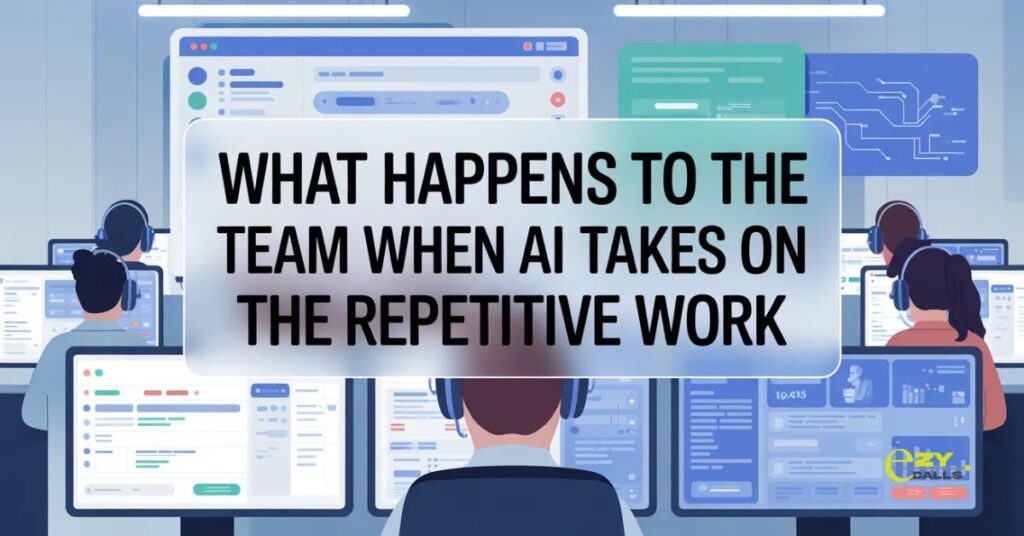
- The concern that comes up most often is what this means for the people already doing customer service.
- Honestly it changes what they spend their time on more than anything else.
- A team that is not spending half the day answering the same basic questions can do more valuable work. Handling the cases that genuinely need attention. Spending real time with customers who have complex problems. Spotting patterns in what keeps coming up and feeding that back into the business.
- That is more satisfying work for the team. It is also more useful for the business. Customer service starts to feel less like a call handling function and more like something that actually strengthens customer relationships.
Actually Works With Artificial Intelligence Customer Service
- Customer service is one of the most direct ways a business shows customers what it values. People experience it firsthand. They remember it. They tell others about it.
- Getting it right consistently with traditional methods alone is a genuine challenge. The hours, the volume, the pace. It adds up to a service that is always reacting rather than staying ahead.
- Artificial intelligence customer service gives businesses a real way to change that pattern. Faster responses. More consistent experiences. Help available when customers need it, not just when someone happens to be at their desk.
- EZY CALLS is built for businesses that want to make this kind of improvement without turning it into a complicated technology project. Straightforward to set up. Practical in how it works day to day. Built around the idea that every customer query deserves a proper response regardless of the time or how busy things get.
Frequently Asked Questions
Q1: How do we keep AI responses accurate when our products or prices change?
- Most platforms make this straightforward to manage. Build a habit of updating the information your AI works from whenever something in the business changes. It does not take long and it makes a big difference to accuracy.
Q2: What happens when AI cannot resolve something?
- Good systems hand the conversation over to a human without the customer having to start again from scratch. The context carries over. The customer does not feel like they have been passed around.
Q3: How do we know if it is actually working?
- Look at how response times change. Look at how many queries get resolved without needing a human. And pay attention to what your team is spending their time on. If they are handling fewer repetitive queries and more meaningful ones the balance is working.