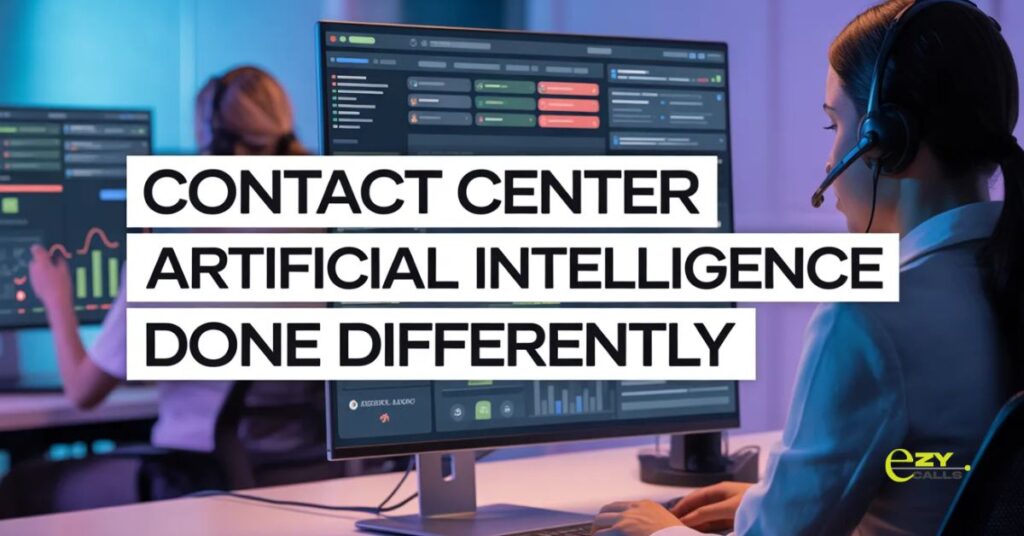
Contact Center Artificial Intelligence Done Differently
- Contact centers have always been under pressure. Handle more. Spend less. Keep customers happy while doing both.
- For years the answer was hiring. More agents. More training. More management overhead. The costs kept climbing and the pressure never really went away.
- Contact center artificial intelligence has changed what is possible. Not by replacing the people doing the work but by changing what that work actually looks like day to day.
What Most Businesses Miss About AI
- The conversation around AI in contact centers tends to focus on cost reduction. Fewer agents needed. Lower cost per interaction. Reduced overhead.
- Those outcomes are real. But businesses that go in focused only on cost tend to miss the more valuable shift.
- Contact center artificial intelligence done well does not just make the existing operation cheaper. It makes the customer experience meaningfully better. Faster responses. More accurate information. Less friction at every point of contact.
- That improvement in experience has its own commercial value. Customers who get good service stay longer. They spend more. They refer to others. The financial return goes well beyond what shows up in a cost per interaction report.
How AI Changes the Daily Reality
- Picture a typical busy period in a contact center without AI. The queue builds. Wait times climb. Agents rush through interactions to keep up. Quality drops. Customers who have been waiting fifteen minutes arrive at the front of the queue already frustrated.
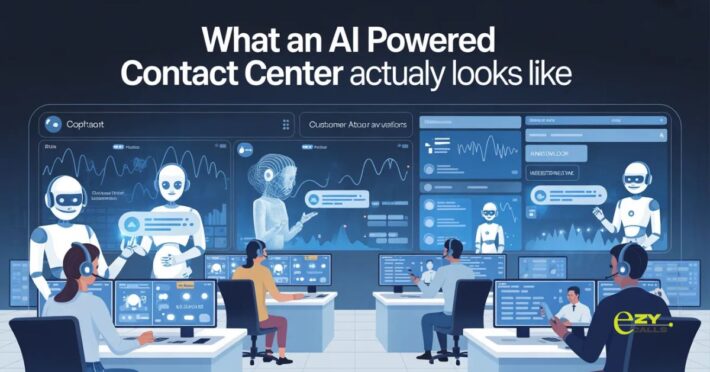
- With contact center artificial intelligence handling the routine contacts that picture looks different. The queue is shorter because a significant portion of contacts never join it. Agents are not rushing because volume is not overwhelming them. The customers who do reach an agent wait less and arrive in a better frame of mind.
- That change in environment affects everything. Agent performance. Customer satisfaction. The overall feel of the operation.
The Contacts AI Handles Best
- Not every contact is the same and not every contact benefits equally from automation.
- Straightforward information requests. Account queries. Standard troubleshooting. Booking confirmations. Status updates. These follow predictable patterns with known answers. AI handles them faster and more consistently than a person can.
- The more complex end of the contact spectrum is different. A customer dealing with a sensitive situation. A complaint involving multiple departments. A long standing client with a complicated history. These need human judgment, careful listening and the kind of flexibility that only comes from experience.
- The businesses getting the most from contact center AI are the ones that have mapped this distinction carefully. They know which contacts belong in the automated flow and which ones need to reach a person quickly. That clarity is what makes the whole system work.
Training the System Properly
- AI is only as reliable as what it has been built on. This is where a lot of implementations run into early problems.
- Information that is out of date. Product details that changed three months ago but never got updated. Policy wording that does not match what agents are actually telling customers. These gaps surface immediately in customer interactions and they are damaging in a way that takes time to recover from.
- Getting the foundation right before going live is not optional. It is the difference between an AI that builds customer confidence and one that erodes it within the first week.
- Keeping that foundation current is equally important. Products change. Policies update. Processes evolve. The AI needs to reflect those changes in real time not after the next scheduled review.
What Happens to the Team
- One of the more interesting shifts that happens when contact center artificial intelligence is implemented well is what it does to the culture of the team.
- Agents who spend less time on repetitive low complexity contacts become more skilled at the complex ones. They develop better judgment. They handle difficult conversations more confidently. Their expertise grows in a way it cannot when most of the day is spent on routine queries.
- That development matters beyond the individual. A team with genuinely strong skills handles the hard situations better. Customer satisfaction on complex contacts improves. The reputation of the contact center improves with it.
Keeping It Working Over Time
- Launch is not the finish line. It is the starting point.
- The contact centers that get sustained value from AI treat it as an ongoing operation not a one time project. Regular reviews of how the system is performing. Agent feedback feeding back into how the AI is configured. Monitoring for gaps before they become patterns.
- Small consistent improvements over time produce far better results than a strong launch followed by months of neglect. The system gets more reliable. The gaps get smaller. Customer experience keeps improving rather than plateauing.
A Smarter Operation With Contact Center Artificial Intelligence
- The contact centers standing out today are not necessarily the biggest ones. They are the ones where the operation runs cleanly. Where customers get fast accurate responses. Where agents are focused on the work that actually needs them.
- Contact center artificial intelligence is what makes that possible at scale. Not as a replacement for good people but as the infrastructure that lets good people do their best work.
- EZY CALLS is a platform built for contact centers navigating exactly this shift. Helping operations move from volume driven pressure toward something more balanced. Where technology handles what it does well and people focus on what only they can do.
Questions Worth Asking
How do we manage the transition without disrupting current operations?
- Start with a narrow implementation. One contact type. One channel. Get that working well before expanding. A phased approach keeps disruption minimal and gives the team time to adjust alongside the technology.
What if our contact types are too varied for AI to handle reliably?
- Most contact centers have more predictable volume than they initially think. Look at the data before drawing that conclusion. Even if only thirty percent of contacts are suitable for automation that still significantly changes what the team is dealing with every day.
How do we get agent buy in for AI in the contact center?
- Be transparent about what it is for and what it is not for. Agents who understand that AI is taking the repetitive work off their plate rather than threatening their role tend to engage with it positively. Show them what their work will look like after implementation, not just what the technology does.