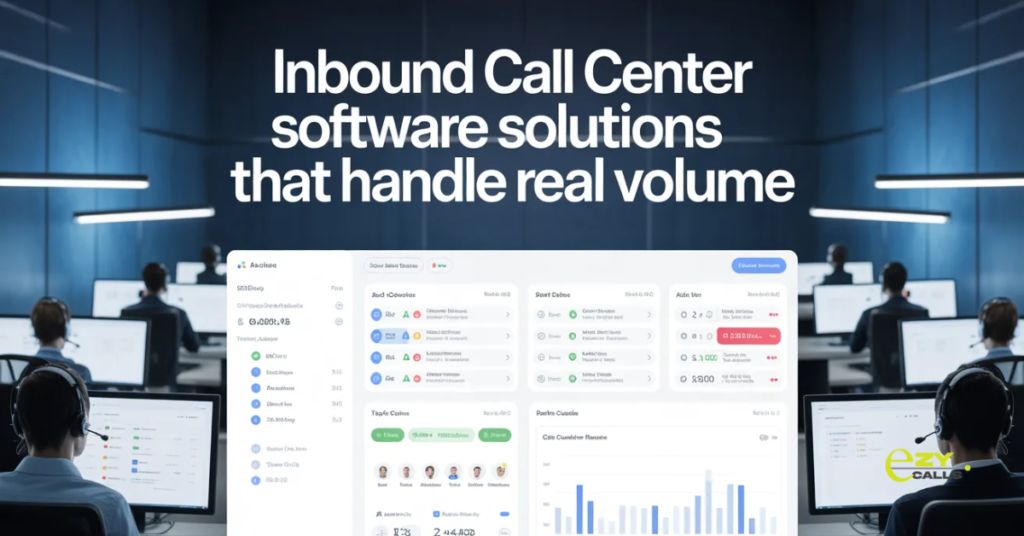
Inbound Call Center Software Solutions That Handle Real Volume
- Inbound call centers face a version of the same problem every day. The volume of contacts arriving does not distribute itself conveniently across the hours the team is available. Peaks that stretch capacity beyond what can be handled well. Quieter periods where the same team is underused. The gap between what customers expect when they call and what the operation can consistently deliver.
- Managing that gap through staffing alone is expensive and never fully successful. Hire enough people to handle peak volume and they are underutilised most of the time. Staff for average volume and peak periods produce wait times that damage customer experience and the reputation that comes with it.
- Inbound call center software solutions change the terms of that problem. Not by making it disappear but by giving operations the tools to handle it more intelligently than headcount adjustments alone allow.
What Inbound Call Center Software Actually Does
- The baseline function is call routing and queue management. Contacts arriving get distributed to available agents in a way that balances wait times against matching the contact to the right resource.
- Beyond that baseline the capability that matters for customer outcomes and operational performance goes considerably further.
- Skills based routing. Contacts directed to agents whose capability matches the nature of the contact rather than simply the next available person. A technical query reaching a technical specialist. A billing dispute reaching someone with the authority and training to resolve it. A returning customer with a complex history reaching someone with the time and context to handle their specific situation.
- IVR and self service. Contacts that can be resolved without an agent handled before they join the queue. Account balance queries. Standard information requests. Appointment confirmation. These contacts get resolved faster than any agent interaction could deliver them and without consuming agent capacity that should be going to contacts that actually need it.
- Queue management that keeps customers informed. Accurate wait time estimates. Call back options that remove the cost of holding. Position in queue information that allows customers to make an informed decision about whether to wait rather than holding indefinitely without knowing whether help is close or still far away.
- Real time supervisor visibility. The operational picture that allows supervisors to respond to what is actually happening rather than to what was forecast. Agents who are struggling are visible before the situation affects the customer. Queue building in one area visible while capacity sits idle in another.
- Inbound call center software solutions that deliver all of these capabilities give an operation tools that staffing decisions alone cannot provide.
The AI Layer That Changes the Economics
- Inbound call center software solutions in 2026 increasingly include AI capabilities that change the economics of inbound contact handling in ways that were not possible with earlier technology.
- Automated handling of routine contacts. Contacts that follow predictable patterns with known resolutions handled without agent involvement. The volume that consumes agent capacity on low complexity contacts gets absorbed by AI. The queue that agents manage contains genuinely different work.
- That shift in queue composition changes what agents spend their time on. Less repetitive low value contact handling. More complex situations where their skill and judgment actually affect the outcome. That is better work for agents and better service for the customers whose contacts need real attention.
- Real time agent assistance. AI that surfaces relevant information during a live call without the agent needing to search for it. Product details. Customer history. Suggested responses based on how similar queries have been resolved. The agent handles the conversation. The AI supports them with the information that conversation requires.
- Predictive analytics. Understanding contact volume patterns well enough to improve staffing decisions. Not just historical averages but pattern recognition that identifies when volume is likely to build before it builds. Scheduling that anticipates demand rather than reacting to it.
The Customer Experience That Matters
- Customers calling an inbound center arrive with expectations shaped by previous experiences. Most of those experiences involved waiting. Navigating options that did not match their need. Explaining their situation multiple times to multiple people. Eventually reaching someone who may or may not have been able to help.
- Inbound call center software solutions that are genuinely well implemented change that expectation over time. Contacts that are routine get resolved quickly without unnecessary steps. Contacts that need a person reach one without an obstacle course of automated options that do not fit the situation. When transfers happen the receiving agent has context. The customer does not start over.
- That experience builds confidence in the brand. Customers who consistently get good service when they call contact support with different expectations than those who have learned to dread it. Those different expectations affect how the interaction goes. Customers who expect to be helped tend to be easier to help than those who arrive already frustrated by anticipated difficulty.
What Supervisor Tools Need to Deliver
- The supervisor function in an inbound call center is where operational management happens in real time. The decisions supervisors make based on what they can see determine whether the operation absorbs demand variation smoothly or allows it to create service failures.
- Real time queue visibility. Not a dashboard that refreshes every few minutes but a current picture of what is happening now. Contacts waiting. Expected wait times. Agent availability. Queue building in specific skills areas. These need to be visible as they happen rather than as a historical record of what happened.
- Agent state visibility. What each agent is doing and for how long. Agents are extended after call work. Agents who have been on a single call longer than expected. Agents whose handle time or quality metrics are showing patterns worth addressing. These are visible to supervisors who have the right tools and invisible to those who do not.
- Intervention capability. The ability to act on what the visibility reveals. Whisper coaching on live calls without the customer hearing. Transferring calls when a situation needs escalation. Redirecting agents from one queue to another when demand patterns shift. These interventions keep the operation running smoothly in real time rather than waiting for a post hoc analysis of what went wrong.
Integration With the Broader Operation
- Inbound call center software that sits in isolation from the broader customer management operation creates friction that undermines efficiency and customer experience simultaneously.
- Customer records that require agents to switch systems to access context they need during a call. Call outcomes that need to be manually recorded in a CRM rather than flowing through automatically. Quality review processes that operate separately from the call recording infrastructure rather than being integrated into it.
- Inbound call center software solutions that integrate with CRM systems, ticketing platforms and quality management tools create a coherent operational environment. The agent has what they need without switching systems. Outcomes flow through automatically without manual recording. The quality management team works from the same contact data as the supervisors rather than from a separate system that needs to be reconciled.
Measuring What Actually Matters
- Inbound call center performance has always been measured heavily on efficiency metrics. Average handle time. First call resolution. Abandonment rate. Cost per contact. These numbers matter and good inbound call center software improves all of them.
- They do not tell the complete story of whether the operation is actually serving customers well.
- Customer effort is the metric that reveals what the experience is actually like. How hard did the customer have to work to get what they needed? How many times did they have to repeat information? How many transfers did they experience? How long did they wait between reaching the IVR and reaching a person who could actually help.
- Customer satisfaction on specific interaction types rather than as a blended score across all contacts. A score that averages across routine contacts that resolved quickly and complex ones that required significant effort masks the detail that would reveal where specific improvements would have the most impact.
- These metrics require deliberate tracking rather than being automatically available from call center infrastructure. Building them into how performance is measured from the start of an implementation produces better information for operational improvement than retrofitting measurement to a system that was built without them.
Building Inbound Operations That Deliver With Inbound Call Center Software Solutions
- The inbound call centers delivering consistently good customer experiences are not the ones with the lowest costs or the most sophisticated technology. They are the ones where contacts reach the right resource quickly and get handled well when they do. Where the operation absorbs demand variation without it becoming visible to customers as service failure. Where the team has the tools to do their jobs properly rather than being set up to struggle.
- Inbound call center software solutions are what make that operational standard achievable. The routing intelligence. The self service capability. The supervisor tools. The AI assistance. Together these create an operation that performs for customers at a level that staffing decisions and goodwill alone cannot sustain.
- EZY CALLS is a platform built for businesses that want to build that kind of inbound operation. Designed around the realities of high volume inbound contact handling and the balance between automated efficiency and genuine human service that customers actually value.
Questions Worth Asking
How do we reduce peak period wait times without significantly increasing staffing costs?
- Self service for routine contacts and AI handling of predictable queries reduce the volume that reaches agents during peak periods. The reduction in agent handled contacts during peaks is often more significant than staffing adjustments for managing peak demand.
How do we improve first call resolution without extending average handle time?
- Better agent information at the point of need reduces the time spent searching for information during calls. Skills based routing that matches contacts to the right agent from the start reduces transfers. Both improve resolution without requiring agents to spend more time on each call.
How do we make quality management sustainable as contact volume grows?
- AI assisted quality monitoring that analyses all contacts automatically against defined criteria makes comprehensive quality management achievable at scale. Supervisor time goes to the contacts where their involvement adds most value rather than being spread thinly across a sample that may not represent the full picture.