
AI Based Call Center and What Building One Actually Involves
- The idea of an AI based call center sounds straightforward enough. Replace or supplement human agents with AI. Handle more contacts. Spend less on staffing. Deliver faster responses. The business case writes itself on paper.
- The implementation is where the straightforward idea meets the complicated reality of how customer service actually works. The customers who do not phrase their queries the way the system expects. The contact types that looked automatable in theory and turned out not to be in practice. The escalation path that works in a demonstration and frustrates customers in production. The knowledge base that was accurate at launch and gradually stopped reflecting what the business had become six months later.
- Building an AI based call center that actually works for customers requires navigating this gap between the straightforward idea and the complicated implementation. This article is about how to navigate it.
What an AI Based Call Center Actually Is
- The term covers a range of implementations that are worth distinguishing rather than treating as a single thing.
- A fully automated contact center handles all customer contacts through AI without human agents involved in the contact handling itself. This exists but it is less common than vendor marketing suggests and it works only for businesses whose contact mix is almost entirely routine and predictable. Most businesses have a contact mix that includes too much complexity and too much emotional content for full automation to serve customers properly.
- A hybrid operation uses AI for the contacts it handles reliably and human agents for the contacts that need people. This is what most well-implemented AI based call centers actually look like. AI handling the high volume routine contacts. Agents handling the complex and emotionally significant contacts that require judgment and empathy. The split between what AI handles and what agents handle reflects honest assessment of where AI is reliable rather than ambition about how much can be automated.
- An AI-augmented operation uses AI primarily to make human agents more effective rather than to replace them. Real time information surfacing during calls. Sentiment monitoring that alerts supervisors to developing situations. After call summarisation that reduces administrative burden. Quality management that covers all contacts rather than a sample. These AI capabilities improve what the operation delivers without the customer-facing automation that generates the most discussion.
- Most effective AI based call centers combine all three of these. Customer-facing automation for contacts where it works. Human agents for contacts where they are needed. AI augmentation for everything, making both the automated contacts and the human-handled contacts better than they would be without AI support.
The Design Decisions That Determine Everything
- The gap between an AI based call center that earns customer trust and one that frustrates customers is almost entirely in decisions made before the technology is deployed rather than in the technology itself.
- What to automate and what not to automate. This is the most important decision and the one most often made incorrectly because it is made from the perspective of what can be automated rather than what should be. The question is not whether AI can handle a contact type. It is whether AI can handle that contact type in a way that leaves customers genuinely better served than if they had spoken to a person.
- High volume contacts with predictable patterns and factual resolutions are good candidates. Account queries. Order status. Standard troubleshooting. Appointment management. Policy information. These serve customers well through automation because the resolution is quick, accurate and available immediately without a queue.
- Contacts where customers are distressed are not good candidates regardless of technical capability. Contacts where the right answer requires flexible judgment that the standard resolution path does not cover are not good candidates. Contacts where the relationship between the customer and the business is valuable enough that impersonal handling damages it are not good candidates.
- Getting this distinction right before deployment determines whether customers find the automation helpful or frustrating. Getting it wrong produces an operation that handles more contacts through AI while delivering worse customer outcomes.
The Information Foundation That Cannot Be Skipped
- Every AI based call center is only as good as the information it works from. This sounds obvious but it is consistently underestimated in implementation.
- The AI that works from accurate current information about the business’s products, services, policies and processes gives accurate answers. The AI that works from information that was accurate at launch and has gradually fallen behind as the business changed gives wrong answers confidently. Wrong answers delivered confidently and immediately are more damaging to customer trust than slow answers from a human that turn out to be right because customers have less reason to question what sounds authoritative.
- The products that launched since the knowledge base was built. The policy that changed last month. The pricing that was updated in the last promotion and then updated again when the promotion ended. Each of these gaps creates contacts where the AI misleads rather than helps customers. The customer who acted on wrong information and then calls back to complain has a worse experience than if the automation had not existed at all.
- Information maintenance is not a setup task. It is an ongoing operational responsibility for as long as the AI based call center is running. Assigning clear ownership for keeping the knowledge base current before deployment, building update triggers into existing business processes and establishing regular review cycles is the operational foundation that keeps an AI based call center accurate over time rather than gradually becoming a source of misinformation.
What Good Escalation Design Looks Like
- Escalation from AI to human agent is the moment in an AI based call center operation that customers feel most directly and that most often reveals whether the implementation was designed around customer experience or around operational efficiency.
- Good escalation feels like good service. The customer who has been talking to an AI and whose contact then needs a person should experience a transition that feels natural and supportive rather than like admitting the machine failed. The agent picks up the full context of what was discussed with the AI. The customer does not repeat themselves. The agent is not starting from scratch. The conversation feels continuous rather than restarted.
- This continuity requires technical implementation that many escalation designs do not achieve. The full conversation transcript available to the agent before they pick up. The customer’s account information surfaced automatically. The reason for escalation is documented so the agent knows what to expect before the first exchange. These things need to be designed specifically rather than assumed to happen because the technology supports them in theory.
- Poor escalation feels like system failure. The customer who spent four minutes explaining their situation to the AI is asked by the agent what the call is about. The account information the AI accessed during the automated interaction is not visible to the agent who now needs to ask for it again. The customer who was transferred without explanation suddenly has a person on the line without knowing why the change happened. These experiences undo the positive impression that effective AI handling might have created and replace it with frustration that sticks.
- The escalation experience matters disproportionately because the contacts that escalate are by definition the ones where the customer needed more than the AI could provide. They are already the contacts where the stakes are higher. Getting the escalation right is what determines whether the customer’s final impression of the interaction is of a business that took care of them or a business that made them work for it.
The Agent Experience in an AI Based Operation
- What happens to agents in a well-implemented AI based call center is one of the more interesting outcomes and one that gets less attention than the technology story.
- When AI handles the routine contact volume consistently the work that reaches agents changes. The agent who used to spend most of their day answering the same account balance query in slightly different forms now handles a different mix. More complex situations. More varied contacts. More interactions where the customer actually needs what an experienced person brings rather than information that could have been retrieved automatically.
- That shift is more demanding in some ways. The contacts that reach agents in a mature AI based operation are genuinely harder than average. They are the ones that AI could not handle. But they are also more engaging. Agents who spend their day on genuinely challenging contacts where their judgment and knowledge matter develop real expertise in ways that agents spending their day on routine volume do not.
- The retention improvement that follows from more meaningful work is real and measurable in operations that have implemented AI properly. Fewer agents leave because the work is repetitive and grinding. More agents are staying and developing. The cost of attrition that contact centers carry as a persistent burden reduces alongside the direct efficiency gains from automated contact handling.
- The transition requires honest management. Agents who understand that AI is changing what their role involves rather than simply threatening it engage differently with the change. The operations that communicate this honestly and invest in developing the skills that complex contact handling requires build teams that benefit from the transition rather than resisting it.
The Technology Stack That Makes It Work
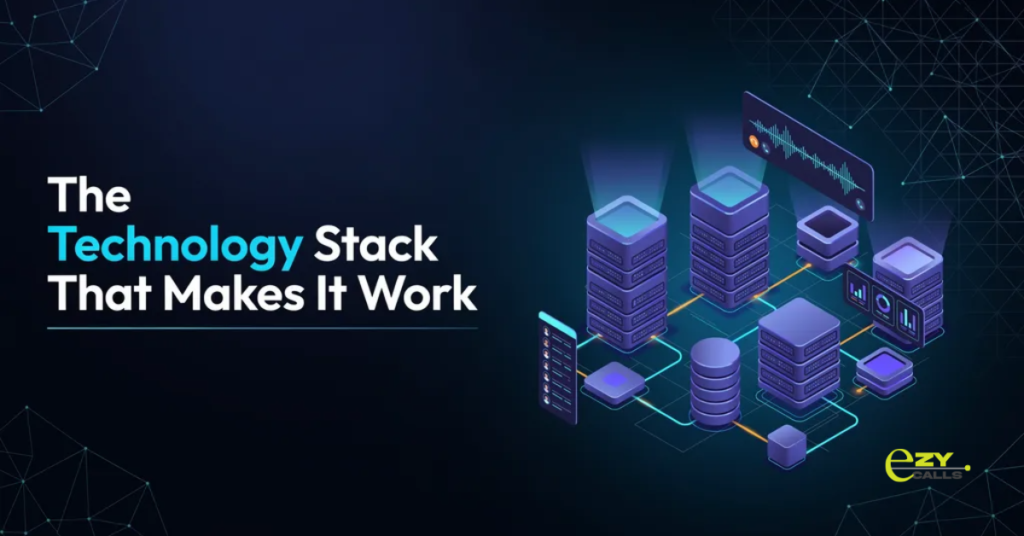
- Building an AI based call center requires technology decisions that connect rather than isolate the components of the operation.
- The AI contact handling needs to connect to the systems that hold customer context. CRM data. Order management. Account history. Known service issues. AI that operates without this context produces responses that are technically accurate but contextually irrelevant. The customer who is told everything is working fine while there is a known outage affecting their area has not been helped. They have been given a correct answer to a question that was not actually their question.
- The quality management system needs to cover AI handled contacts and human handled contacts in the same framework. The operation that measures human contact quality and leaves AI contact quality unmonitored does not have a complete picture of how it is serving customers. Problems in AI handled contacts that are not visible because they are not being reviewed accumulate into systematic failures that only become visible when customer satisfaction scores or churn rates reveal the impact.
- The workforce management system needs to understand what AI is handling and what it is not. A forecast that treats all contacts as needing human handling in the proportions they did before AI deployment will overstaff for human contacts and miss the actual distribution of what reaches agents. Accurate forecasting in an AI based call center reflects what the AI actually handles and what actually reaches people.
- EZY CALLS is built as a coherent platform for businesses building AI based call center operations rather than as separate components that need to be connected. The AI contact handling. The agent assistance. The quality management. The analytics. These work together rather than alongside each other because they were designed as part of the same operational environment rather than as separate products that happen to be sold together.
Questions Worth Asking
How do we define what our AI based call center should handle versus what should always reach a person before we make any technology decisions?
- Start from your actual contact data rather than from technology capability. Categorise your contacts by volume, predictability and resolution complexity. The high volume predictable contacts with factual resolutions are automation candidates. The contacts involving distress, complexity or judgment are not regardless of what the technology can technically attempt. This categorisation before technology evaluation produces a scope that the AI can actually deliver on rather than an ambition that produces a poor implementation.
How do we know if our AI based call center is serving customers rather than just processing contacts efficiently?
- Measure repeat contact rates specifically for contacts that AI handled. Track satisfaction scores from AI handled contacts separately from human handled contacts on comparable contact types. These reveal whether customers are actually getting what they need. An operation that reduces contact handling cost while increasing repeat contacts and reducing satisfaction is not improving customer service. It is moving the failure to a different part of the customer journey.
How do we build an AI based call center that improves over time rather than degrading as the business changes around it?
- Treat the AI based call center as an operational capability that needs ongoing management rather than a technology project that concludes at deployment. Assign ownership for knowledge base maintenance. Build performance review into operational rhythms. Establish clear processes for identifying and addressing gaps when performance data reveals them. The operations that improve continuously are the ones where someone is responsible for the ongoing health of the system rather than just its initial delivery.
